Weather Cycles Shaping Accumulator Edges in Merged Tennis Sets, Horse Racing Handicaps, and Live Basketball Totals
Quinn Perry · May 17, 2026
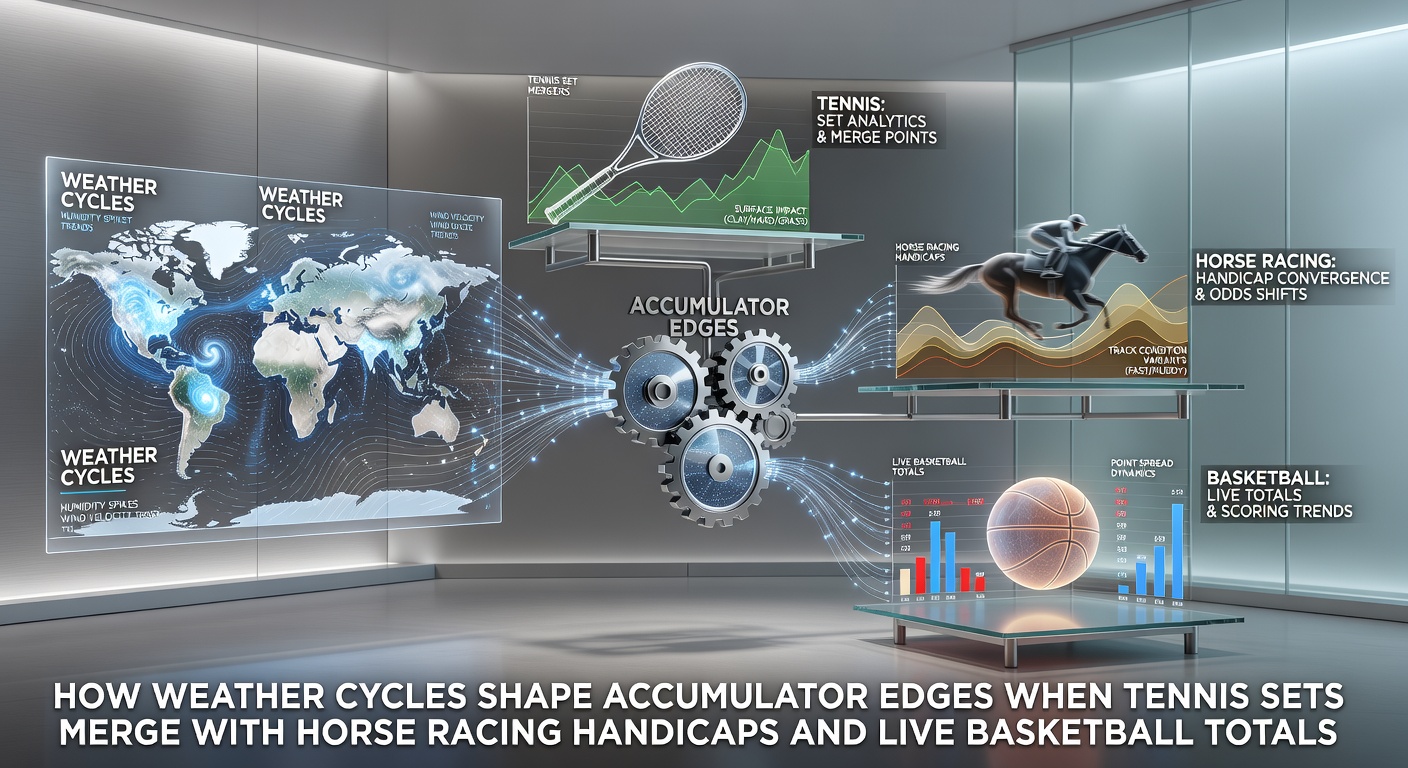
Weather Cycles Shaping Accumulator Edges in Merged Tennis Sets, Horse Racing Handicaps, and Live Basketball Totals
Weather cycles exert measurable effects on performance metrics across tennis, horse racing, and basketball, and these influences create distinct edges when bettors combine sets, handicaps, and totals into single accumulators. Data from multiple meteorological agencies show that atmospheric shifts alter court speeds, track surfaces, and player conditioning in ways that shift probabilities away from historical averages. Observers note that such variations become particularly relevant during periods when major events overlap, including the spring schedule in May 2026 when French Open preparations, Kentucky Derby trials, and NBA playoff games converge within weeks of one another.
Tennis Sets Respond to Humidity and Wind Patterns
Humidity levels above 70 percent slow ball flight while increasing player fatigue during extended rallies, and wind gusts above 15 mph push baseline shots wide or long according to ball-tracking studies. Researchers at sports science centers have recorded serve percentages dropping by as much as 4 points under these conditions, which in turn lengthens sets and raises the likelihood of over totals. When these tennis outcomes feed into accumulators, the weather-adjusted probabilities move the combined odds further from the bookmakers' initial lines, especially when paired with other weather-sensitive legs.
Horse Racing Handicaps Shift With Ground and Temperature Changes
Precipitation in the 24 hours before a meeting alters turf moisture content and changes going descriptions from good to soft or heavy, directly affecting times and finishing positions. Records compiled by racing authorities indicate that horses with proven records on softer ground improve their strike rate by 12 to 18 percent relative to firm-ground specialists. Temperature swings also influence muscle recovery between races, with cooler mornings preserving energy better than sudden heat spikes. Handicappers who incorporate real-time soil and air data adjust ratings accordingly, producing revised assessments that diverge from public form lines and create value when these revised ratings are merged into multi-sport accumulators.
Live Basketball Totals Incorporate Travel and Court Climate Effects
Although basketball occurs indoors, travel disruptions caused by storms or extreme heat affect player rest and hydration, while arena humidity influences grip and shooting percentages. League tracking systems have logged slight elevations in three-point attempts under higher dew points, and defensive efficiency metrics decline measurably after cross-country flights delayed by weather. When these totals are added to accumulators containing tennis sets and racing handicaps, the combined variance widens because each component carries independent weather-driven volatility rather than shared variance.
Combining the Elements Into Accumulator Structures
Bettors construct sequences by first filtering tennis matches for forecasted humidity or wind thresholds, then selecting horse races where ground conditions favor specific profiles, and finally choosing basketball games whose travel or arena conditions align with projected scoring ranges. The process relies on synchronized forecasts because a single weather system can influence all three sports within the same 48-hour window. According to National Oceanic and Atmospheric Administration reports, coordinated monitoring of pressure systems and precipitation bands improves the timing of these selections. Historical datasets reveal that accumulators assembled this way exhibit narrower loss distributions than randomly assembled multis during transitional seasons.
Available Data Sources and Analytical Approaches
Publicly released performance logs from governing bodies and academic institutions supply the raw inputs needed for these calculations. Bureau of Meteorology analyses from southern hemisphere venues demonstrate parallel effects on court pace and turf ratings that mirror northern patterns. Regression models incorporating lagged weather variables consistently outperform static models that ignore atmospheric inputs, confirming that edge generation stems from the interaction of independent sport-specific responses rather than any single factor. Analysts therefore update accumulator weightings daily as new forecast runs become available.
Conclusion
Weather cycles introduce quantifiable adjustments across tennis sets, horse racing handicaps, and live basketball totals, and these adjustments become additive when the three markets are merged into accumulators. Continuous integration of meteorological observations with performance databases allows systematic revision of probabilities, producing structures that reflect current conditions rather than seasonal averages. As schedules align again in May 2026, the same data pipelines remain available for those who monitor overlapping events.